Panda Express vs Chipotle vs McDonald's: Calories, Protein, and Sodium Compared (2026)
How does Panda Express compare to Chipotle and McDonald's for calories, protein, and sodium? See the full head to head nutrition breakdown for 2026.
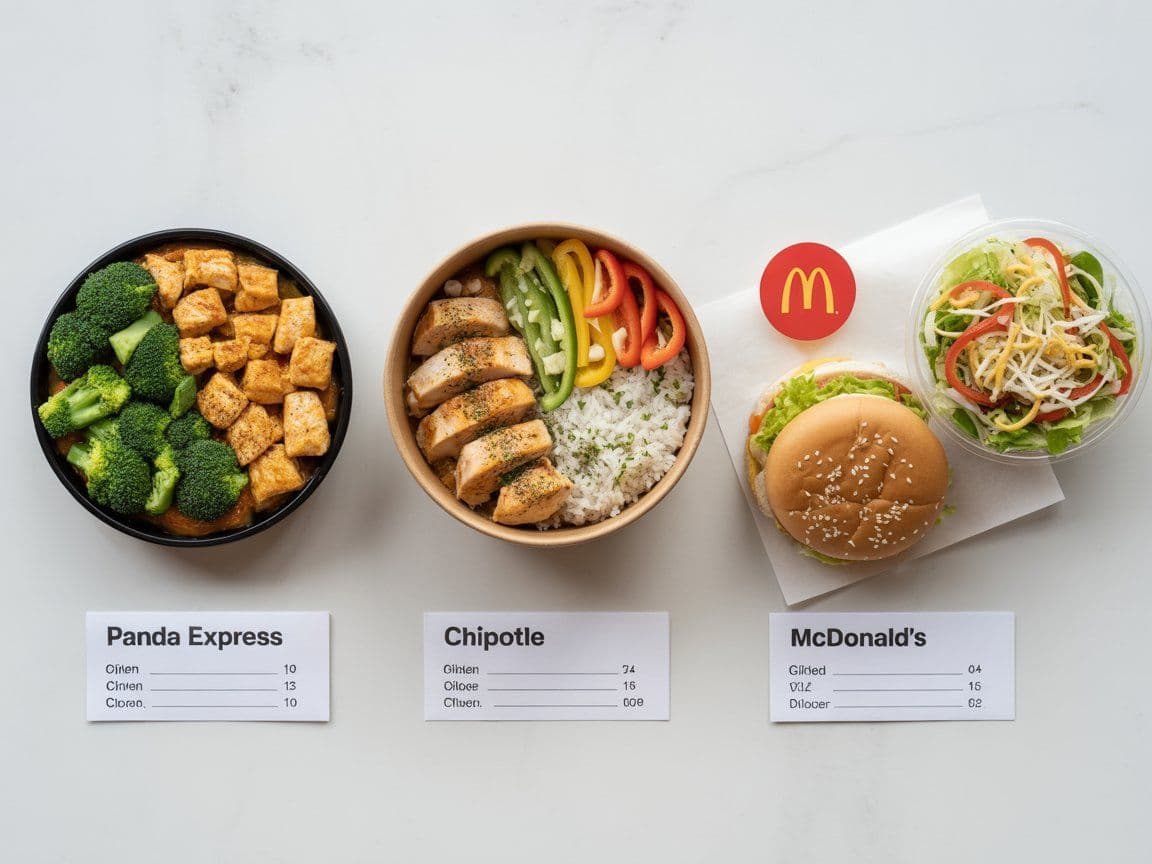
Panda Express vs Chipotle vs McDonald's: Calories, Protein, and Sodium Compared (2026)
If you are trying to eat well and you are deciding between Panda Express, Chipotle, and McDonald's, the differences in nutrition are significant. The same type of meal built at each chain can range from under 600 calories to well over 1,400 depending on your choices. This guide compares the most popular meals at all three chains across calories, protein, sodium, and fat so you can make an informed decision the next time you are choosing where to eat.
The Big Picture: How These Chains Compare
Before getting into specific items, here is a high level overview of how Panda Express, Chipotle, and McDonald's differ in terms of what they offer nutritionally.
Panda Express offers the most flexibility of the three. You build your own plate from a mix of entrees and sides, which means the same visit can produce a 490 calorie high protein plate or a 1,600 calorie indulgent meal. The range is wide and the choice is entirely yours.
Chipotle is generally perceived as the healthier option, and for good reason. Their build your own bowl format allows you to load up on lean protein, beans, rice, and vegetables. However, the add ons like cheese, sour cream, queso, and guacamole can push a bowl well past 1,000 calories quickly.
McDonald's has the least flexibility of the three. Most items come as fixed combinations with limited ability to customize down. The healthier options exist but they are fewer in number and harder to build around for high protein goals.
Calories Compared: Most Popular Meals
Here is how the most commonly ordered meals at each chain compare in total calories:
PANDA EXPRESS
Classic Plate (Orange Chicken, Fried Rice, Beijing Beef): around 1,590 calories
Healthy Plate (Grilled Teriyaki, Super Greens, Broccoli Beef): around 555 calories
Average bowl ordered by customers: around 900 to 1,100 calories
CHIPOTLE
Chicken Burrito with rice, beans, cheese, sour cream, salsa: around 1,150 calories
Chicken Bowl with rice, beans, and fajita veggies, no dairy: around 720 calories
Steak Bowl with lettuce and salsa only (no rice): around 490 calories
MCDONALD'S
Big Mac Meal with fries and a Coke: around 1,330 calories
Grilled Chicken Sandwich with side salad: around 540 calories
Quarter Pounder with Cheese and no sides: around 520 calories
Key takeaway: All three chains can produce both very light and very heavy meals. The difference is how much control you have over the outcome. Panda Express and Chipotle give you the most customization. McDonald's gives you the least.
Protein Compared: Which Chain Wins?
Protein is where Panda Express genuinely outperforms the other two chains when you order correctly.
PANDA EXPRESS
High protein Plate (Grilled Teriyaki plus Teriyaki Chicken, Super Greens): 745 cal, 80g protein
Standard Plate average: 30 to 45g protein
Lowest protein Plate (Orange Chicken, Beijing Beef, Fried Rice): around 36g protein despite being 1,590 cal
CHIPOTLE
Double protein Chicken Bowl with rice and beans: around 900 cal, 65g protein
Standard Chicken Bowl: around 720 cal, 42g protein
Steak Bowl with minimal toppings: around 490 cal, 35g protein
MCDONALD
'SDouble Quarter Pounder with Cheese: 740 cal, 51g protein
Grilled Chicken Sandwich: 540 cal, 36g protein
McDouble: 400 cal, 22g protein
For high protein eating, Panda Express wins when you order strategically. The combination of Grilled Teriyaki Chicken and Teriyaki Chicken as a Bigger Plate delivers 80g of protein under 750 calories, which neither Chipotle nor McDonald's can match without significantly higher calorie counts.
Sodium Compared: The Hidden Number
Sodium is the area where all three chains struggle, and it is worth paying attention to if you are managing blood pressure or heart health.
PANDA EXPRESS
Healthiest Plate sodium: around 1,000 to 2,000mg depending on choices
Average meal sodium: 1,800 to 2,400mg
Highest sodium meals: can exceed 3,000mg with items like Wok Fired Shrimp and Chow Mein combined
CHIPOTLE
Standard Chicken Bowl with all toppings: around 1,700 to 2,200mg sodium
Light bowl with no cheese or sour cream: around 1,000 to 1,400mg sodium
The beans and rice alone at Chipotle contribute significant sodium before the protein is even added
MCDONALD'S
Big Mac: 1,010mg sodium
Large fries: 400mg sodium
Big Mac Meal total: around 1,600 to 2,000mg sodium with drink and fries
Grilled Chicken Sandwich: 800mg sodium
All three chains can hit or exceed the recommended daily sodium limit of 2,300mg in a single meal if you are not careful.The lowest sodium full meal across all three chains is actually a well built Panda Express Plate using Broccoli Beef, Steamed Ginger Fish, and White Steamed Rice, which comes in around 1,000mg total.
Fat Compared: Which Meals Are Highest in Fat?
Total fat content varies dramatically based on what you order at each chain. PANDA EXPRESS
Super Greens: 3g fat
Broccoli Beef: 7g fat
Orange Chicken: 24g fatBeijing Beef: 26g fat
A full classic Plate can reach 55 to 70g of total fat
CHIPOTLE
Chicken Bowl with guacamole, cheese, sour cream: 50 to 65g fat
Chicken Bowl with no dairy add ons: 15 to 20g fat
Guacamole alone adds 19g of fat, though it is mostly unsaturated
MCDONALD'S
Big Mac: 30g fatLarge fries: 17g fat
Big Mac Meal: around 50g fat total
Grilled Chicken Sandwich: 6g fat
Chipotle's fat content is heavily influenced by guacamole and dairy add ons, which are mostly optional. McDonald's fat is concentrated in the beef patties and fried items. Panda Express fat peaks with battered and fried entrees like Orange Chicken and Beijing Beef.
Value for Nutrition: Which Chain Gives You the Most?
If you define value as the most protein per dollar at the most reasonable calorie count, here is how the three chains rank:
For weight loss, a strategically built Panda Express Plate (Super Greens, Broccoli Beef, Black Pepper Sirloin) at around 490 calories is hard to beat at any fast food price point.
For high protein dieting, Panda Express again leads when you use Grilled Teriyaki Chicken as your base. No other major fast food chain offers 33g of protein at 275 calories as a single item.
For overall food quality perception, Chipotle tends to score highest among consumers due to fresher ingredients and a cleaner brand image, though the nutritional difference between a well built Panda Express Plate and a well built Chipotle Bowl is smaller than most people expect.
For convenience and speed, McDonald's wins on accessibility and price, though its nutritional ceiling for healthy eating is lower than the other two chains.
Bottom Line: Which Should You Choose?
If your goal is the healthiest possible meal at a fast food chain, a strategically built Panda Express Plate competes directly with Chipotle and outperforms McDonald's on protein density. The key word is strategic. Defaulting to the most popular items at any of these chains produces a similar result: a calorie heavy, sodium heavy meal that does not serve most diet goals well.
The real advantage at Panda Express is the flexibility to go extremely light or to stack protein in a way that is harder to achieve elsewhere. Use the nutrition calculator before you order and the math works in your favor.
See Your Exact Panda Express Nutrition Before You Order
Use the Panda Express Nutrition Calculator to build your meal and see real time calories, protein, sodium, fat, and carbs for every combination. Free, no account needed, and works on mobile.